|
Produced, Directed and Choreographed
by
Ian
Clark
Musical Director
Dennis Mason
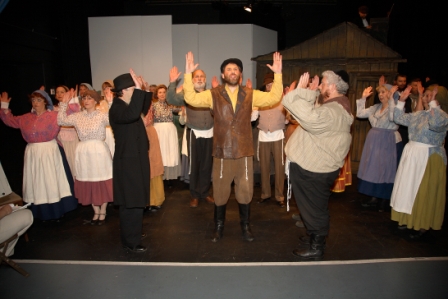
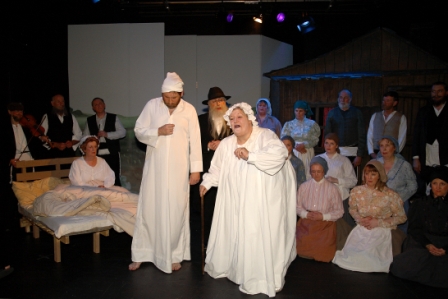
People of
Anatevka
|
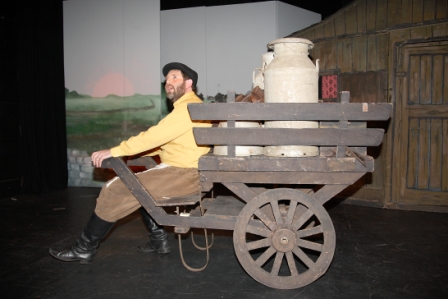
Tevye |
– |
Kerry Applin |
|
Golde |
– |
Ann Dent-Smith |
|
Tzeitel |
– |
Liz Bradbury |
|
Hodel |
– |
Sarah Howe |
|
Chava |
– |
Stephanie Clark |
|
Shprintze |
– |
Nadege Lindsay |
|
Bielke |
– |
Kristina Woodthorpe |
|
Yente |
– |
Mandy Clowes |
|
Motel |
– |
Ian Clark |
|
Perchik |
– |
Mark Donalds |
|
Lazar Wolf |
– |
Ray Bill |
|
Mordcha |
– |
Richard Smith |
|
Rabbi |
– |
Geoff Moore |
|
Mendel |
– |
Andrew Smith |
|
Avram |
– |
Nigel Cox |
|
Nachum |
– |
Brian Youngman |
|
Grandma Tzeitel |
– |
Kaye Lee-Wright |
|
Fruma-Sarah |
– |
Nadine Darnley |
|
Shandel |
– |
Shirley Howells |
|
The Fiddler |
– |
Meryl Moore |
Other Villagers
Patricia Cahill,
Elaine Carter, Kym Chalker,
Christine Cox, Bronwyn Mason, Kathy Pinkstone,
Sam Spivey, Pat White
Russians
Fyedka – Steve
Bradbury
Constable/Russian Singer – Peter Lindsay
Tony Lee-Wright, Nadine Darnley, Bronwyn Mason
About the show
When
Fiddler on the Roof opened on Broadway in
1964, it was intended that Danny Kaye would take
the lead role. In the even, Zero Mostel created
the role on stage and Topol later starred in the
film.
The
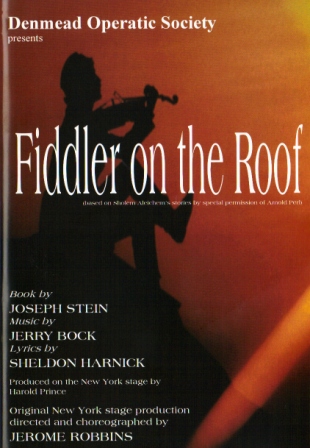
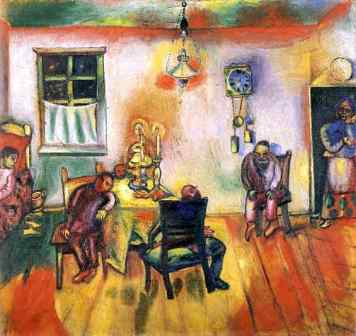
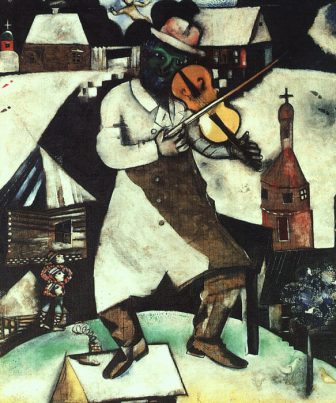
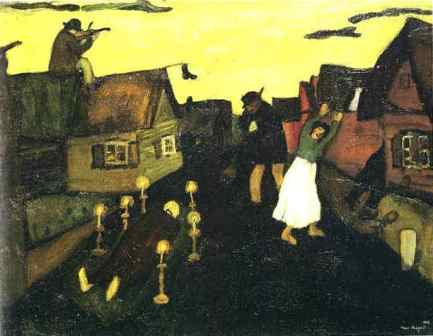
title comes from one of Chagall’s famous series
of pictures with fiddlers, bridal couples, cows
and more, flying over Russian villages – crazy
and delightful (see below). The fiddler is a
visual metaphor of survival through tradition
and joyfulness.
The
musical itself is based on the books of Sholem
Aleichem, especially Tevye’s Daughters.
Tevye is a milkman with five daughters (who will
all need husbands) living in a Russian village
in 1905 where Jews and Russians co-exist
uneasily. He is a warm and complex character,
loving, humorous, devout but questioning,
wanting to be rich but also to be a scholar,
rooted in tradition but struggling to accept new
ideas.
The
play is very truthful to the book. Sholem
Aleichem writes as though he and Tevye were old
friends meeting up from time to time. Tevye
talks to him, jokes with him, tells him his news
and views on the life God has given him. Jewish
readers of the original books would have found
Tevye’s mis-translations of the Bible from
Hebrew into Yiddish vastly entertaining.
The
music in the show is also true to the way of
life Sholem Aleichem knew and wrote about. It is
full of exuberance and also sadness, of deep
religious feeling as well as some macabre
“happenings”. You leave the theatre humming the
songs, but at a deeper level, you are also
haunted by them.
Perhaps the great strength, and the great
sadness, of Fiddler on the Roof is that
although we are separated from the people of
Anatevka by over a century and a thousand miles,
their feelings are as recognisable to us today
in a world where there is still hatred between
people of different races and religions, but
where courage, dignity and humour still shine
through.
|